
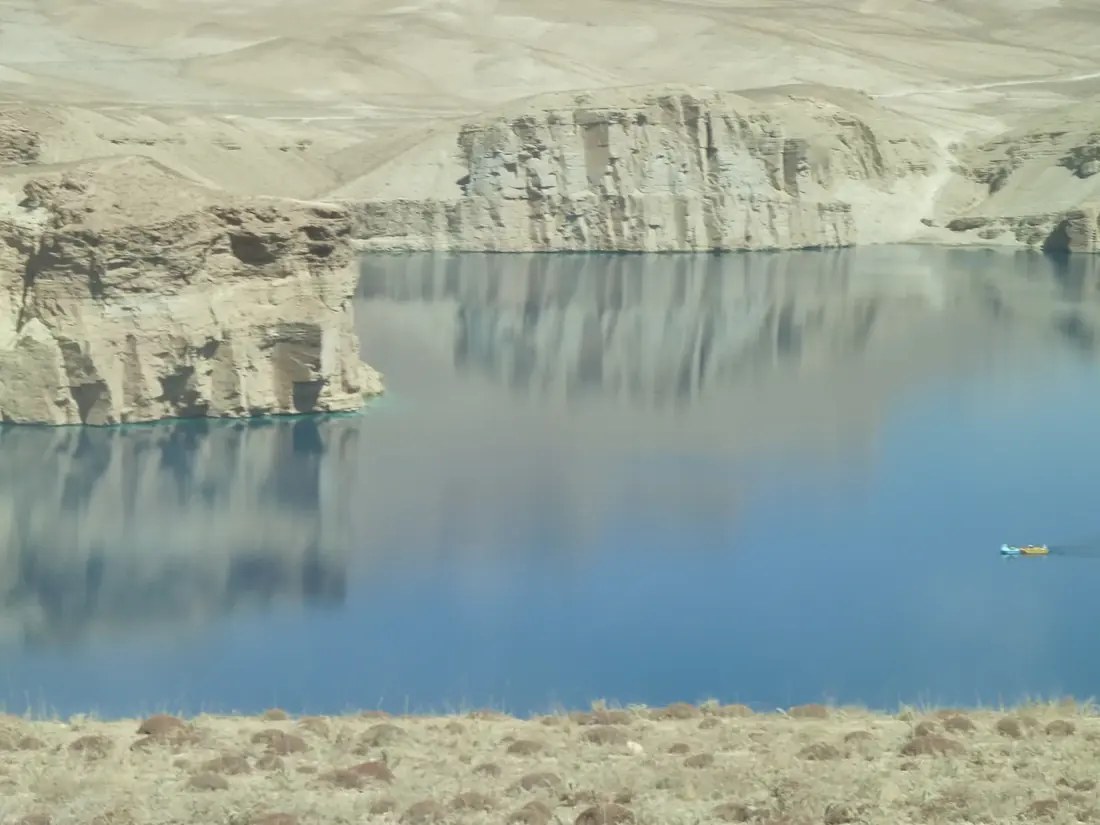
Band-e-Amir is a chain of deep-blue lakes in Bamyan province, held back by natural stone dams. It is Afghanistan’s first national park, and for many visitors it is the single most striking landscape they see in the country. This guide focuses on the park itself: what it is, how a visit is usually built from Bamyan town, which papers you need, and how the season changes the day.
It is a companion to our combined article, Bamyan and Band-e-Amir: How to Visit, which covers the valley, the Buddha niches, and the lakes together. Use that post for the wider circuit. Use this one when you are trying to understand Band-e-Amir on its own. For visa, flights, and packing, see Travel to Afghanistan. For the steps from first message to a permit, see how booking works.
What Band-e-Amir is
The lakes sit in a high limestone landscape west of Bamyan town. Mineral-rich water has built pale travertine barriers, and the basins behind them read turquoise or sapphire in good light. The colour is real, but it changes with sun, cloud, and the season, so photographs from a different month are a poor promise of what you will see.
The park is a chain, not a single pond. Band-e Haibat is the lake most visitors reach first, with the main viewpoints and the usual first walk. Other lakes in the chain have their own names and characters. On a short day trip, you will not walk every shoreline, and not every lake is equally easy to reach. That is normal. A good visit is unhurried time at the water you can actually get to, not a race to name every basin.
The setting is high. Tour.af’s existing visit notes describe the lakes as sitting around three thousand meters. If you have come straight from Kabul, walk slowly for the first hour. The air is thinner than it feels in a city street, and a simple slope can be enough to remind you.
How you get there
Almost every foreign visitor reaches Band-e-Amir via Bamyan town, not as a same-day dash from Kabul. The drive from the capital to Bamyan is already a full morning or more, with checkpoints on the way. From Bamyan town to the park, Tour.af’s travel guide and visit notes describe the road as roughly one and a half to two hours, depending on the day and the checkpoints. Treat those figures as a planning range, not a guarantee for your date.
The common pattern is a day trip from Bamyan: an early start, park entrance formalities on site, time at the main lake, and a return to Bamyan in the afternoon. Overnight stays near the lakes exist in some seasons, but they need a clear plan with your guide before you leave town. Do not assume there will be a room at the water’s edge if it has not been arranged.
Domestic flight options in and out of the region change. Many trips still use the road from Kabul. Your quote should say which.
Permits, tickets, and checkpoints
A tourist e-Visa gets you into Afghanistan. It does not, by itself, clear you for Bamyan province. Provincial travel permits are issued through the government Afghan Tour office in Kabul. Bamyan has to be on that paper if you plan to stay or sightsee there. Tour.af includes the letter of invitation and the permits with the quote, written to the itinerary you actually booked.
On arrival in Bamyan you may still need to register with a local culture or tourist office before you leave for the park or buy certain site tickets. Those desks are commonly closed on Friday and shorter on Thursday, which is why a guided trip builds the arrival day around that timetable. Independent timing that ignores it can cost you a day.
The national park entrance ticket is separate from the provincial permit. Pay it on the ground. Older blog posts and travel forums often quote prices that are no longer right. Site ticket prices change; treat any number you read online as a check-on-arrival figure, not a promise.
Expect to show your passport and permit more than once between Bamyan and the park. That is ordinary, not a sign that something has gone wrong. Carry copies as well as the originals, and keep the permit with you in the vehicle.
When to go
Season matters more here than it does on a Kabul city street. Our Travel to Afghanistan guide lists spring, April to June, as a particularly strong time for Band-e-Amir, including the period when the lakes are often at their best colour. Autumn, September to November, is the other comfortable window for most visitors, with some of the clearest light of the year.
Summer is workable and can be busy with domestic visitors. Winter is a different calculation: snow can close or slow the road, and the trip becomes a weather decision, not a scenic extra. If you want a fuller month-by-month view of Afghanistan as a whole, see best time for an Afghanistan tour.
Access rules at the park can change, and they are not applied the same way every week. Confirm the plan with your operator the day before you go, and keep a backup day in Bamyan town if the road or the park is not open to your group.
What a guided day looks like
With a licensed guide and driver, a Band-e-Amir day is usually straightforward. You leave Bamyan once registration is done and the road is reported open. You travel with the permit in the car. At the park you pay the entrance ticket, walk the main viewpoints around Band-e Haibat, and — if time and conditions allow — continue to another lake in the chain. You eat a simple lunch as arranged, and you return to Bamyan before the day gets late.
The official translator and guide requirement for foreign tourists still applies. This is not a place to wander off the permitted path with a rented car and a downloaded map. The value of the guide at the lakes is partly the setting; on the road it is the paperwork and the checkpoints.
Photography is one of the reasons people come. It is also easy to overdo. Ask before you photograph local visitors at close range, and be careful near edges and on wet travertine. The dams are beautiful and they are not a paved promenade.
How Band-e-Amir fits an itinerary
Band-e-Amir is not a half-day add-on to a Kabul city week. Tour.af’s private Kabul week stays in and around the capital and does not include Bamyan or the lakes. If you want the park, you need a route that includes Bamyan province, enough nights in Bamyan town, and permits written for that itinerary.
A classic first circuit is Kabul, then Bamyan, then a full day at the lakes, then a return to Kabul or a continuation to the next region on a longer trip. Two nights in Bamyan is the calmer plan if you also want the Buddha niches and a fortress without rushing. Current trips that can include this region are listed on the Afghanistan tours page. A longer cultural journey such as the 10-day Silk Road Highlights trip at $2,499 may include highland days when that is how the booked route is written — always check the itinerary rather than assuming the lakes are automatic.
Do not try to stack Bamyan, Band-e-Amir, Herat, and the Wakhan into a single short week. The Wakhan is its own expedition, in a different season, from $3,200 on Tour.af’s small-group departure. The permit follows the plan you confirmed, not the junction you happen to pass.
Practical notes
- Walk slowly at first. The park is high, and a first hour of gentle movement is more useful than a fast circuit of viewpoints.
- Bring a warm layer even in summer. Wind on the lakes can feel colder than Bamyan town.
- Carry passport, e-Visa print, permit, and copies whenever you leave Bamyan.
- Friday timing in Bamyan can affect registration. Build the arrival around it.
- International flights, the visa fee, and specialist travel insurance are not included in tour starting prices. Park tickets are typically paid on site.
- Tell us if anyone in the group is sensitive to altitude, so the day can be paced accordingly.
If you want help building Bamyan and Band-e-Amir into a trip, send your dates and group size. WhatsApp +93 70 521 4101. There is no deposit to start, and you get a clear quote before you pay for flights. The letter of invitation and permits come with that quote. Start with Afghanistan tours or the booking steps in how booking works, and keep Bamyan and Band-e-Amir: How to Visit open for the valley side of the same journey.
Comments